 By
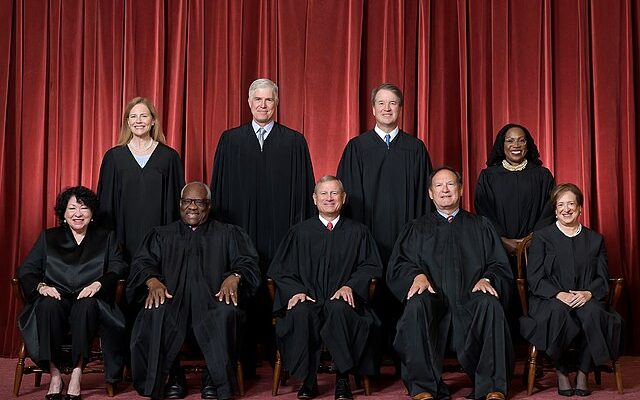
By Supreme Court Justice Samuel Alito was briefly hospitalized last month after falling ill during a dinner in Philadelphia, according to a report from CNN, which cited sources familiar with the incident.
The episode occurred on March 20 following a Federalist Society symposium held in Alito’s honor at the University of Pennsylvania Law School. Individuals with knowledge of the event said Alito became ill during a post-symposium dinner. His security detail transported him to a nearby hospital, where he was evaluated and treated for dehydration with fluids. He returned to his home in Virginia later that same night.
Neither Alito nor the Supreme Court’s public information office offered on-the-record comment regarding the incident, which had not previously been reported.
In the weeks since, Alito has resumed his duties on the bench, participating in oral arguments and appearing in good health during proceedings.
He is expected to author one of the biggest opinions of the court this term. The Supreme Court’s long-awaited decision in Louisiana v. Callais is now expected to be authored by Alito, the only member of the Court who has not yet written a majority opinion from the October 2025 sitting. With the case being the final holdover from that term, speculation has intensified that he will pen the opinion narrowing—or potentially sharply limiting—the scope of Section 2 of the Voting Rights Act.
A ruling in this direction would have profound ramifications for congressional redistricting, particularly in the South. For decades, Section 2 has empowered courts and legislatures to create majority-minority districts to prevent the dilution of Black and other minority voting strength, a holdover from 60 years ago that has essentially granted gerrymandered districts to Democrats across the South. An Alito-authored opinion curtailing that authority could open the door for Republican-led state legislatures in states such as Louisiana, Alabama, Georgia, Mississippi, and North Carolina to redraw maps by “cracking” these districts, converting safely Democratic seats into more competitive or Republican-leaning ones. Analysts project this could shift as many as 8 to 15 House seats in Democrats’ favor over the coming cycles.
The justice, who turned 76 this week and has served on the court for two decades, has also been the subject of renewed speculation about a possible retirement. He has declined to address questions on the matter when pressed by reporters.
Information about the health of Supreme Court justices has historically been closely held. In 2020, the court’s public information office initially declined to disclose that Chief Justice John Roberts had suffered a fall at a country club in suburban Maryland that resulted in a head injury and required hospital treatment. That incident was later reported by The Washington Post.
Any decision by Alito to step down would carry significant implications for the court’s future composition. It would give President Donald Trump the opportunity to appoint a fourth justice to the nine-member court, adding to the three he selected during his first term.
Friends of Alito told CNN that he has at times considered retirement, though no final decision appears imminent.
On the bench, Alito has remained a consistent supporter of many of Trump’s policy initiatives when they have come before the court. During oral arguments this week involving birthright citizenship, he appeared more receptive than some colleagues to arguments challenging the longstanding interpretation that grants citizenship to individuals born on U.S. soil.
Appointed by President George W. Bush in 2006, Alito has emerged as one of the court’s most influential conservative voices. He authored the 2022 majority opinion overturning Roe v. Wade, ending federal constitutional protection for abortion rights, and has played a central role in cases involving voting law.
The March 20 symposium, titled “An Examination of the Jurisprudence of Samuel Alito,” featured presentations from former law clerks, legal scholars, and attorneys who frequently appear before the court. While the event was livestreamed, it was not open to the press. Alito did not attend the daytime sessions and was not listed as a participant. Earlier that morning, the Supreme Court released opinions with Alito absent as he traveled to Philadelphia.
Dean Reuter, executive vice president of the Federalist Society, did not respond to inquiries about the justice or the group’s Philadelphia events.
The night before, Alito attended a separate gathering in Washington honoring Notre Dame law professor Sherif Girgis, a former clerk. Girgis received the Edwin Meese Originalism Award from the Meese Institute for the Rule of Law, part of an organization founded by former Vice President Mike Pence. Girgis also participated in the Philadelphia symposium but did not respond to CNN’s requests for comment.
[Read More: ActBlue Caught Red-Handed]