 By
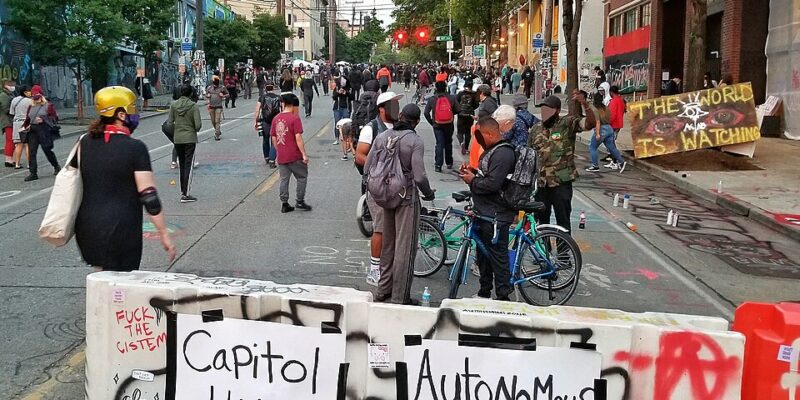
By Residents in a North Seattle neighborhood, frustrated by repeated gunfire near their homes, have begun building makeshift barricades in the street in an effort to deter violence they say has grown increasingly dangerous.
Over Memorial Day weekend, neighbors near North 98th Street and Linden Avenue North used dirt, gravel, logs and pieces of concrete to partially block access to several residential roads, according to local reports. They say the goal is to disrupt activity tied to prostitution along Aurora Avenue, which they believe has contributed to a recent series of shootings.
🚨THEY VOTED FOR IT: Seattle residents are forced to build DIY barricades to protect themselves from roving gangs shooting up their neighborhoods after defunding their police, harboring dangerous illegal aliens and electing radical Leftist @MayorofSeattle Katie Wilson. pic.twitter.com/kUjAoFAUOO
— Dapper Detective (@Dapper_Det) May 25, 2026
The extraordinary move comes as blue states and cities face growing pressure from residents and businesses who say high taxes, permissive crime policies, and declining public order have made daily life harder to justify. Some states have responded to population and income flight by considering “exit taxes” on those who leave. But in Seattle, the crisis has taken a more immediate form: neighbors say they are trying to stop bullets from entering their homes.
“It’s either this, or bullets in my neighbor’s houses,” resident Peter Orr told reporters.
Neighbors say they have documented at least eight shootings within roughly 10 blocks over the past month, using police incident logs, surveillance footage and physical evidence such as shell casings. In one incident, bullets struck the outside of a home and came close to a bassinet where a six-week-old infant was sleeping.
“We celebrate when there’s not a shooting,” said resident Kate, who declined to provide her last name out of privacy concerns.
The barriers were assembled after consecutive nights of gunfire intensified anxiety in the neighborhood. Supporters argue that enough routes remain open for cars and emergency vehicles, and that residents had few other options after repeated violence near their homes.
But the effort has divided some neighbors, with critics warning that the obstacles could interfere with emergency response times.
River Alexander, another resident, said the barricades could create serious risks if firefighters, paramedics or police need to reach someone quickly.
“I think that the risk of emergency services not being able to get through here, and the impediment that could cause to people’s actual lives, is greater than the good they think they’re doing from putting up this,” Alexander said.
Orr and other supporters say the immediate threat posed by shootings is more urgent, particularly for families with children.
“There’s a real gray area there,” Orr added. “But nobody wants to wake up to one of their neighbors being dead.”
The Seattle episode fits into a broader pattern across heavily Democratic states and cities, where residents and businesses are increasingly making decisions based on the practical consequences of leftwing governance. IRS migration data cited in the earlier report showed that Americans are moving both themselves and their income away from blue states and toward red states. States that voted for Donald Trump gained a net $37.2 billion in income and roughly 492,000 filers, while states that supported Kamala Harris lost about $40.8 billion and more than 520,000 filers.
California alone lost roughly $11.9 billion in adjusted gross income, New York lost about $9.9 billion, and Illinois lost around $6 billion, while Florida gained more than $20 billion. The corporate movement has followed the same pattern, with companies and executives leaving high-tax, high-regulation states for friendlier climates.
JPMorgan Chase CEO Jamie Dimon pointed directly to the burden in New York, stating, “The truth is that while New York City has much going for it, particularly for financial companies (because of extraordinary local talent), it also has the highest city and state corporate taxes and the highest individual income and state taxes.”
Even some Democratic officials have acknowledged the problem. New York Gov. Kathy Hochul, addressing the erosion of her state’s tax base, said, “Maybe the first step should be go down to Palm Beach and see who you can bring back home because our tax base has been eroded.”
Yet in many places, the policy response has not been to make those states easier to live in, work in, or do business in. Instead, some lawmakers have considered new wealth taxes and even mechanisms aimed at taxing people as they leave. Sandra Swirski, founder and CEO of Integer, described how such a system would work, saying, “You tally up the value of your home, your cars, your furniture, your assets, your stocks, your bonds, your art and there is a tax on that value.” She added, “The value of these assets, your net worth, in some cases is very easy to calculate, stocks and bonds and alike. In other cases it’s really difficult to calculate.”
The Seattle barricades tell a different side of the same story. In some places, residents are leaving because the costs are too high. In others, residents who remain are improvising defenses because they believe government is failing at its most basic responsibility: maintaining public order.
City regulations require permits for structures placed in public streets, and unauthorized barriers can lead to fines, removal orders, and costs billed to those responsible. It remains unclear whether residents sought permits before building the roadblocks.
Seattle police have acknowledged the frustration and said officers continue to patrol the Aurora area when resources allow. But for residents who say they have endured weeks of gunfire, that response has not been enough.
The deeper question is not merely whether residents should be allowed to build roadblocks in public streets. It is why they believed they had to do it in the first place.
If a state or city is well run, people do not need to be taxed for leaving. And if a neighborhood is safe, families do not need to build barricades to sleep through the night. When these ordinary people start to leave, will the mayor wave “bye” like she did to millionaires who’ve packed up and left over her plan for an income and wealth tax?
[Read More: Oregon Looks To Ban Hunting, Meat]