 By
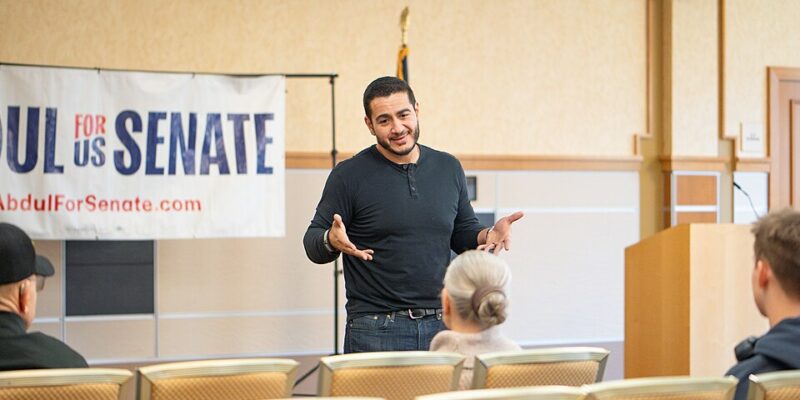
By A prominent Detroit pastor urged his radio listeners to campaign for Democratic Senate candidate Abdul El-Sayed without disclosing that El-Sayed’s campaign had paid the pastor’s nonprofit $75,000 for political consulting.
Horace Sheffield III, pastor of New Destiny Christian Fellowship and host of The Wake-Up Call on FaithTalk 101.5 FM, delivered an enthusiastic endorsement of El-Sayed last week. Sheffield urged listeners to make “5 and 10 phone calls” on behalf of the progressive candidate ahead of Michigan’s Aug. 4 Democratic primary.
“Lord, help this man win,” Sheffield said.
“You can’t buy authenticity,” El-Sayed replied.
It turns out you can. Campaign finance records, however, show that El-Sayed’s campaign paid $75,000 to the Ecumenical Ministers Alliance, a nonprofit led by Sheffield and registered to his home address, according to an investigation by The Washington Free Beacon.
The campaign made 10 payments of $7,500 between Oct. 21 and June 1, listing the expenses as “political consulting.” Neither Sheffield nor El-Sayed disclosed the financial relationship during the radio interview.
Sheffield has promoted El-Sayed on the air and through social media at least three times without mentioning the payments.
During a Dec. 6 interview, Sheffield pledged to “put my full force of soldiers” behind El-Sayed’s campaign. On June 20, he recorded a video from El-Sayed’s campaign headquarters predicting that El-Sayed would defeat Rep. Haley Stevens in the Democratic primary.
The Ecumenical Ministers Alliance formally endorsed El-Sayed last month. El-Sayed said he was “deeply honored” by the endorsement and prominently lists it on his campaign website.
Sheffield’s support could be especially valuable to El-Sayed, who has struggled to gain traction with Black voters. Stevens, considered the more moderate candidate in the race, holds a substantial advantage among Black Democrats in Michigan.
During the recent interview, Sheffield repeated El-Sayed’s attacks on corporate political action committee money and promoted the candidate’s support for Medicare for All. He also criticized Stevens, referring to her only as “the person who is running” and claiming she “has never been seen” in Detroit.
The paying off of “nonprofits” in order to land endorsements has become a key tactic in Democratic money laundering.
Kamala Harris’s 2024 presidential campaign gave $500,000 to Sharpton’s National Action Network shortly before Sharpton conducted a friendly MSNBC interview with Harris. The campaign made two $250,000 payments, on Sept. 5 and Oct. 1, before the interview aired on Oct. 20.
Sheffield serves as president of the Michigan chapter of the National Action Network and has described Sharpton as his “long time friend.” Sharpton presented Sheffield with a lifetime achievement award in 2015.
President Donald Trump later cited reporting on the Harris campaign’s payments to Sharpton while questioning whether Democrats had effectively purchased support from prominent media and entertainment figures.
Sheffield has previously faced scrutiny for endorsing a political candidate after that candidate paid his nonprofit.
In 2018, radio station WFDF suspended Sheffield after he endorsed Democratic gubernatorial candidate Shri Thanedar without revealing that Thanedar’s campaign had paid tens of thousands of dollars to the Ecumenical Ministers Alliance for consulting.
Thanedar is now a progressive Democratic member of Congress representing Detroit.
WFDF owner John Adell said at the time that Sheffield’s undisclosed endorsement placed the station in a difficult position.
“I’ve got an FCC license that I have to worry about. You have to offer equal time to every candidate,” Adell told the Detroit Free Press.
After the controversy, Sheffield promised, “I won’t be involved in any more campaigns.”
Campaign finance records from the same election cycle showed that three other Michigan candidates — Kevin Robbins, Tracy Green, and Terra Defoe — each paid the Ecumenical Ministers Alliance $750. The payments were classified as “endorsement fees.”
It remains unclear whether Sheffield personally receives income from the nonprofit.
Salem Media, which owns FaithTalk 101.5 FM, distanced itself from Sheffield’s endorsement and emphasized that he purchases airtime for an independently produced program.
“We completely reject the endorsement of Abdul El-Sayed made during this paid programming,” a Salem Media spokeswoman said.
“Pastor Horace Sheffield is not a Salem Media employee and has no affiliation with Salem Media other than purchasing airtime for his independently produced program. Salem Media is supporting Mike Rogers for U.S. Senate, and the views expressed during this paid program do not reflect the views of our company.”
Salem Media describes itself as a “Christian and conservative media leader.”
Neither El-Sayed’s campaign nor Sheffield responded to requests for comment about the payments or the failure to disclose them during the interview.
[Read More: Liberal Host Stuns Crowd By Reading What DSA Actually Say]