 By
By President Trump is weighing a targeted military strike against Iran as early as this week, with the possibility of a broader campaign later this year that could extend to regime change, according to sources familiar with internal White House discussions.
The president has told advisers that if diplomacy—or even an initial limited attack—fails to force Tehran to abandon its nuclear program entirely, he would consider a larger assault aimed at removing Supreme Leader Ayatollah Ali Khamenei from power, according to The New York Times. No final decision has been made. But Trump has signaled a preference for an opening strike in the coming days to send a message: Iran must give up the capability to develop nuclear weapons.
Potential initial targets include the headquarters of Iran’s Islamic Revolutionary Guard Corps, key nuclear facilities, and components of the country’s ballistic missile program. Administration officials privately question whether airstrikes alone could accomplish the more ambitious objective of toppling Iran’s leadership.
The deliberations come amid a significant U.S. military buildup. Two aircraft carrier strike groups — including the USS Gerald R. Ford, recently repositioned toward the region — along with fighter jets, bombers, refueling aircraft, and other assets are now within striking range. The deployment represents one of the largest U.S. force concentrations in the Middle East in more than twenty years.
Even so, diplomatic channels remain open. U.S. and Iranian negotiators are scheduled to meet in Geneva on Thursday for what sources describe as last-ditch indirect talks.
A proposal reportedly advanced by Rafael Grossi, director general of the International Atomic Energy Agency, would allow Iran to conduct very limited nuclear enrichment solely for medical research and treatments, such as producing isotopes at facilities like the Tehran Research Reactor.
The framework is designed as a face-saving compromise. Tehran could argue it retains a measure of enrichment capability. Washington could maintain that weaponization pathways have been dismantled. Whether either side will accept such a formulation remains uncertain.
The administration’s public position has been firm. Through special envoy Steve Witkoff, officials have insisted on “zero enrichment” as the only acceptable outcome. Iran’s Foreign Minister Abbas Araghchi, appearing recently on CBS’s “Face the Nation,” reiterated Tehran’s stance. “I believe that still there is a good chance to have a diplomatic solution,” he said, adding, “So there is no need for any military buildup, and military buildup cannot help it and cannot pressurize us.” He further maintained that Iran would not surrender what he described as its “right” to produce nuclear fuel under the Nuclear Nonproliferation Treaty.
Earlier options involving special operations forces conducting ground raids on deeply buried nuclear or missile facilities have, for now, been shelved because of the risks involved. Military leaders have also raised concerns about the strain a prolonged confrontation could place on naval readiness, Patriot missile systems, and other defense resources.
The Iranian foreign minister has said that he is hopeful of averting war but claimed that Iran would not be afraid of striking back if fighting did come to pass.
The White House declined to address specifics. Spokesperson Anna Kelly said: “The media may continue to speculate on the President’s thinking all they want, but only President Trump knows what he may or may not do.”
Beyond the nuclear issue, officials describe a broader rationale for potential action: protecting Iranian protesters amid recent crackdowns, countering missile threats to Israel, and disrupting Tehran’s support for groups such as Hamas and Hezbollah. Yet even within the administration, there is recognition that U.S. strikes could trigger a nationalist backlash inside Iran—potentially strengthening the very regime Washington seeks to weaken.
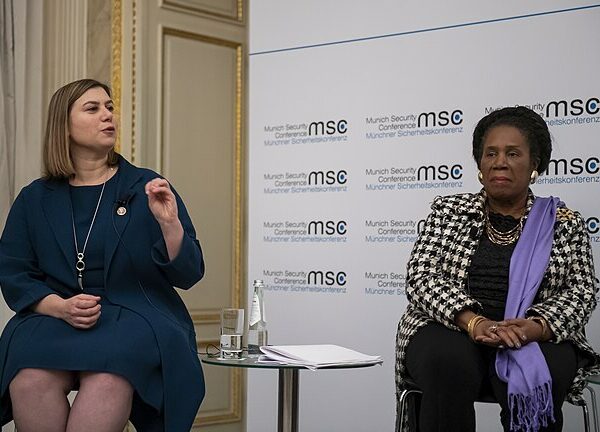
European diplomats at the recent Munich Security Conference expressed skepticism that military pressure alone would persuade Tehran to abandon a program it has long framed as an assertion of sovereignty and resistance to the United States.
As negotiators prepare for Thursday’s meeting in Geneva, the central question remains whether a gap can be bridged between Washington’s demand for full dismantlement and Tehran’s insistence on limited, sovereign enrichment. The answer may determine whether the coming days bring diplomacy—or war.
[Read More: Teacher Banned For Helping Start Turning Point USA Club]