 By
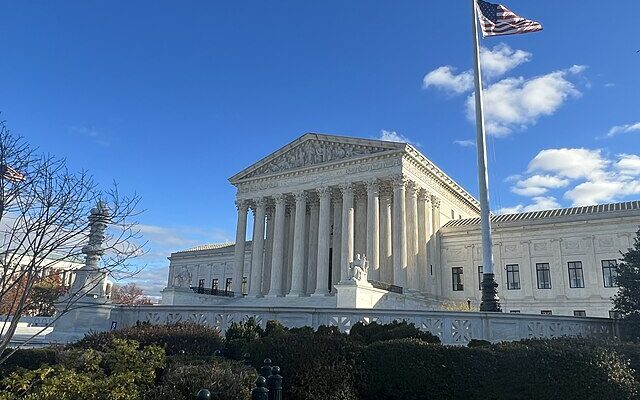
By The U.S. Supreme Court is expected to potentially issue a ruling as early as Friday on the legality of President Donald Trump’s tariff policies, a decision that could reshape trade policy, executive authority, and federal revenue streams.
While no decision is guaranteed on that date — which is scheduled as an opinion release day — legal observers say the tariff case is widely expected to be addressed, given the court’s calendar and mounting speculation surrounding the dispute, according to Fox Business.
At the center of the case is whether the executive branch lawfully relied on the International Emergency Economic Powers Act (IEEPA) to impose sweeping duties on imports. The justices are also weighing whether an adverse ruling would require the federal government to refund tariffs already collected from importers — a move that could carry major fiscal consequences.
Analysts caution that the court is unlikely to deliver a clean win for either side. Treasury Secretary Scott Bessent on Thursday characterized the likely outcome as a mixed ruling.
“What is not in doubt is our ability to continue collecting tariffs at roughly the same level, in terms of overall revenues,” Bessent said during an appearance in Minneapolis. “What is in doubt, and it’s a real shame for the American people, was the president loses flexibility to use tariffs both for national security, for negotiating leverage.”
The Trump administration has argued that IEEEPA provides broad authority to act in response to national security threats, including efforts to stem the flow of fentanyl into the United States. Critics counter that the statute was never intended to justify long-term trade policy.
Economists warn that invalidating the tariffs could reverberate beyond the courtroom. Jose Torres, a senior economist at Interactive Brokers, said the administration would likely seek alternative paths if the court intervenes.
“If the court blocks the tariffs, the administration is going to find workarounds,” Torres said. “President Trump is very ambitious in getting this agenda through despite potential controversies that could surround such a decision.”
Torres added that striking down the tariffs would undercut key policy goals. “Blocking tariffs would be bad for onshoring ambitions. It would be bad for fiscal conditions, rates would go higher,” he said. “But it would be good for corporate earnings. Input prices would be lower and trade would be smoother.”
Administration officials note that other legal tools remain available, including provisions of the 1962 Trade Act, which could preserve much of the tariff regime even if IEEEPA authority is narrowed. The more immediate concern, however, would be refunds: tariffs generated roughly $195 billion in fiscal year 2025 and $62 billion so far in 2026, revenue now factored into deficit-reduction efforts.
Financial markets are already signaling uncertainty. One prediction platform places the odds of the tariffs being fully upheld at just 28 percent.
Analysts at Morgan Stanley say the Supreme Court has ample room to split the difference. “We do think there’s scope for the administration to take a lighter-touch approach to the overall tariff regime given a recent political focus on affordability,” Morgan Stanley analysts Ariana Salvatore and Bradley Tian wrote.
So far, the economic effects of the tariffs have been more muted than early critics predicted. Inflation pressures have remained limited, the U.S. trade deficit has fallen sharply to its lowest level since the 2009 financial crisis, and the United States has not faced broad isolation in global trade.
The Atlanta Fed’s GDPNow model now estimates real GDP growth of 5.4% for the fourth quarter of 2025, up sharply from 2.7% just three days earlier. The massive increase follows new data releases from federal statistical agencies and industry surveys. The model shows stronger consumer spending, with projected personal consumption growth rising from 2.4% to 3.0%, and a major swing in trade, as net exports are now expected to add 1.97 percentage points to GDP growth instead of subtracting 0.30 points.
[Read More: GOP Stops Omar Cash Grab]