 By
By Democrats will always double down to protect “the Americans that they care most about.” Minnesota Lt. Gov. Peggy Flanagan ignited a sharp political backlash after appearing in a hijab and offering an “As-salamu alaykum” greeting during a Christmas Day visit to a Minneapolis store serving the city’s Somali community—a gesture supporters framed as solidarity and critics derided as performative excess.
Remember, these are the same women who claim that Donald Trump wants to introduce the “Handmaid’s Tale” to the United States and dress up in character from the book and show.
A DC resident shared this photo she took at Union Station yesterday. Looks like a scene from the Handmaid's Tale, but no, just another day of Trump's militarization of DC right now. #UnderHisEye pic.twitter.com/lXJaAFmohU
— Jennifer Bendery (@jbendery) September 3, 2025
In a video that circulated widely on social media, Flanagan praised Minnesota’s Somali population, estimated between 80,000 and 100,000 residents, calling the community “part of the fabric of the state of Minnesota.” She highlighted a 25-year friendship with Somali community leader Nimco Ahmed and urged Minnesotans to support Somali-owned businesses. Throughout the visit, the lieutenant governor wore Islamic modesty coverings as she spoke directly to community members.
BREAKING: MN Lt. Governor Flanagan puts on hijab, declares Somalis built Minnesota pic.twitter.com/acCUZoRHXN
— End Wokeness (@EndWokeness) December 26, 2025
The appearance followed heightened anxiety among Somali residents stemming from President-elect Donald Trump’s campaign rhetoric on immigration, including his calls for mass deportations and his criticism of Somali migrants in the context of fraud investigations tied to federal aid programs. Flanagan’s visit was presented by her office as an effort to reassure residents who fear renewed immigration enforcement under the incoming administration.
The reaction, however, was swift and polarized. Conservative commentators seized on the imagery, accusing Flanagan of cultural pandering and symbolic politics untethered from policy reality. Viral posts mocked the visit, with some exaggerating her remarks to claim she suggested Somalis “built Minnesota,” a characterization not reflected in her actual comments but one that fueled online backlash. Supporters pushed back, defending the community’s role in the state’s economy and civic life.
Some noted that the move reminded them of how local leaders act after being conquered.
The controversy unfolded against the backdrop of the Feeding Our Future scandal — a $250 million fraud case involving federal child nutrition funds, with many defendants linked to Minnesota’s Somali community. Trump has repeatedly cited the case as evidence of systemic abuse, further intensifying scrutiny of immigration and welfare policy in the state. Together, the Somalian community in Minnesota may have stolen roughly $9 billion, roughly half of Somalia’s entire economy.
A liberal judge in Minnesota recently overturned a criminal judgment by a jury that found one of the fraudsters guilty, allowing them to keep millions.
🚨 INFURIATING: A Minnesota leftist judge OVERTURNED a Somali fraud guilty verdict, which was UNANIMOUS.
"The judge didn't [even] say the fraud didn't happen!"
Tim Walz's Minnesota is DEEPLY corrupt. Voters need to CLEAN HOUSE!pic.twitter.com/fAINkI5Q8F
— Eric Daugherty (@EricLDaugh) December 26, 2025
Flanagan’s critics argue that her gesture glosses over the fact that over 80 percent of Somali households, regardless of how long they have been in the United States, are on welfare.
🚨 INFURIATING: 81% of Somali households are on welfare.
73% get Medicaid, versus 18% of native-born American households.
54% get food stamps, versus 7% native-born.
These LEECHES need to be deported en masse! And banned from reentry! pic.twitter.com/NEJUNkQDh8
— Eric Daugherty (@EricLDaugh) December 11, 2025
Minnesota is not the only place to see problems rise from the immigration of Somali immigrants. In Denmark, the same immigrants have refused to assimilate into that culture, as well.
The Danes have been publishing detailed crime statistics and other social outcomes of immigrant groups since the late 90s.
It's shocking how poorly some specific groups manage to integrate, how much violence they bring, and how expensive it is for the Danish state to host… https://t.co/PEcu4orgPl
— DHH (@dhh) November 26, 2025
In the book Why Nations Fail, economists Daron Acemoglu and James A. Robinson argue that Somalia’s persistent instability flows from a deeply ingrained social order that has long resisted centralized authority. Power has historically been distributed among competing clans and networks, with loyalty owed to kin rather than to impersonal institutions, leaving no durable state capable of enforcing law uniformly. In that environment, violence, smuggling, and coercion were not aberrations but accepted tools of survival and status, filling the vacuum left by the absence of a monopoly on force. Crime flourished because there was no consistent authority to deter it, contracts remained unenforceable, property rights insecure, and investment risky. The result, Acemoglu and Robinson contend, was a culture in which predation became normalized, armed groups supplanted civic institutions, and disorder perpetuated itself—not as a temporary breakdown, but as a structural feature of a society organized without centralized rule of law.
President Donald Trump on November 21 terminated deportation protections for Somalis in Minnesota, claiming that “Somali gangs are terrorizing the people of that great State, and BILLIONS of Dollars are missing.”
The timing has also drawn attention. Flanagan is widely viewed as a potential contender in Minnesota’s 2026 U.S. Senate race, where immigration is expected to be a central issue and where opponents such as Republican Royce White have embraced hardline positions, including calls for mass deportations.
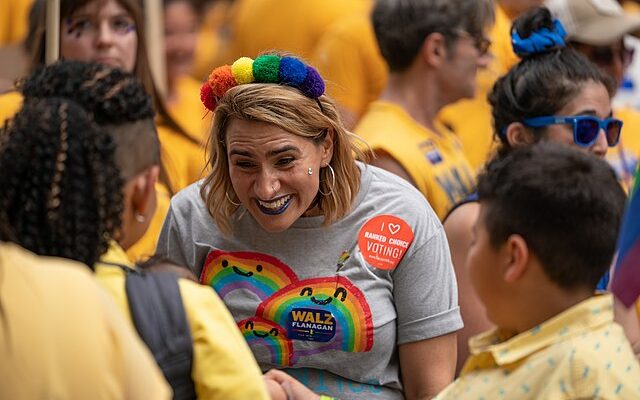
Flanagan has already revealed herself as a radical. As Lt. Governor to Tim Walz, she came under fire for wearing a shirt that appeared to threaten to kill anyone who challenged allowing children to take hormones that will make them sterile or have sex changes. Within a year, a transgender shooter attacked a Catholic church, killing children. The shooter had similar messaging on his gun.
I do think it’s notable that this is the Lieutenant Governor of Minnesota and her choice of messaging. https://t.co/nLvDeZrzZM pic.twitter.com/MadR9XRary
— Magills (@magills_) August 27, 2025
Taken together, this controversy reflects how radical the Democratic Party has become and why party leaders have reportedly refused to publish their own 2024 post-election autopsy, wary that a candid accounting would expose how deeply leftwing orthodoxy, cultural signaling, and activist priorities alienated broad segments of the electorate. Flanagan’s actions fit squarely within that pattern. Instead of confronting hard questions about immigration enforcement, welfare dependency, public safety, or voter trust, Democratic officials continue to insulate themselves from criticism by doubling down on symbolic gestures and moral posturing. The message is clear: they won’t change and are simply hoping for a cyclical victory to implement their radical plans on the rest of us.
[Read More: Europe Furious With Rubio]