 By
By The U.S. military carried out strikes Saturday on 10 targets inside Iran after Iranian forces launched a drone attack on an oil tanker moving through the Strait of Hormuz, U.S. officials said.
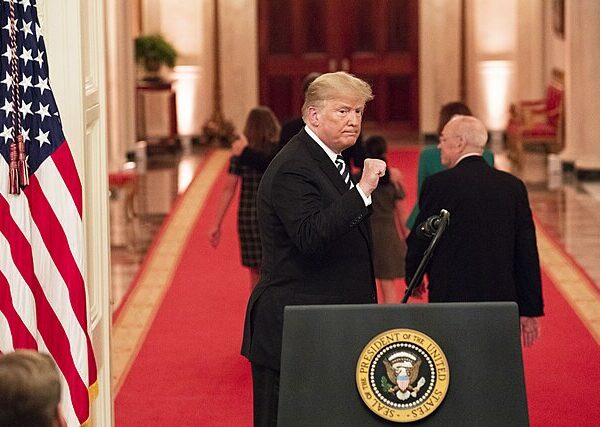
The strikes were ordered by President Donald Trump and targeted Iranian military infrastructure tied to surveillance, communications, air defense, drone storage, and minelaying capabilities near the strategic waterway, according to U.S. Central Command.
CENTCOM released video of one strike showing a burst of smoke after impact. The operation marked another direct U.S. response to Iranian attacks that have tested a fragile ceasefire between Washington and Tehran.
President Trump announced the strikes on Truth Social, writing that “United States aircraft just struck Iranian missile and drone storage locations, and coastal radar sites, for violating the Cease Fire Agreement, AGAIN!”
The president also issued a broader warning to Tehran.
“There may come a point when we are no longer able to be reasonable, and will be forced to militarily complete the job that we very successfully started. If that happens, the Islamic Republic of Iran will no longer exist!”
U.S. officials said Iranian forces attacked the oil tanker Kiku with a one-way drone earlier Saturday. The vessel was carrying more than two million barrels of crude oil after leaving a Qatari oil field and heading toward a port in the United Arab Emirates. It was traveling along an alternative route near Oman’s coast rather than through Iranian waters.
The U.S. military said Iran “had a chance to honor the ceasefire agreement” but “elected not to.”
Iranian state television reported explosions in an area north of the Strait of Hormuz.
The attack followed another confrontation days earlier, when an Iranian drone struck a merchant vessel off the coast of Oman on Thursday. U.S. forces responded with strikes the next day, underscoring how quickly the ceasefire has come under strain.
Bahrain’s Foreign Ministry said several Iranian drones targeted the country earlier Saturday, calling the attack “a flagrant threat to the security of citizens and residents.” No immediate damage or casualties were reported. Bahrain hosts the U.S. Navy’s 5th Fleet.
Iran’s Revolutionary Guard claimed in a statement carried by state media that it had struck several locations “of the U.S. terrorist army in the region,” but did not identify the targets.
Vice President JD Vance warned Friday night that Iran should “pick up the phone” if disputes arise over the ceasefire agreement, “but violence will be met with violence.”
The latest strikes come as the United States and Iran continue negotiations under an interim agreement giving both sides 60 days to reach a final deal. The talks center on several major flashpoints, including safe passage through the Strait of Hormuz, Iran’s nuclear program, its stockpile of highly enriched uranium, and the conflict in Lebanon involving Israel and the Iranian-backed group Hezbollah.
After the attack on the Kiku, the British military’s United Kingdom Maritime Trade Operations center confirmed that a tanker had been struck in the strait. Officials said the crew was safe and no environmental damage had been reported.
The U.S. Navy-overseen Joint Maritime Information Center later said it would expand the alternative route near Oman’s coast to handle both inbound and outbound traffic.
Iran has insisted that Tehran governs transit through the Strait of Hormuz and has called for ships to follow Iranian rules, including possible transit fees. The United States and Gulf Arab states have rejected those demands, arguing that the waterway must remain open as an international route even though parts of it fall within Iranian and Omani territorial waters.
Maritime authorities have warned that shipping remains under significant threat because of mines and ongoing naval clearance operations. The International Maritime Organization has suspended new efforts to move additional vessels out of the area until stronger guarantees against further attacks are in place.
About 115 ships have already exited the strait in recent days.
The repeated military exchanges show how difficult it will be to maintain even a temporary pause in hostilities while the broader negotiations continue. For the Trump administration, the message to Tehran was clear: attacks on commercial shipping and U.S. partners in the region will bring a direct American response.
[Read More: Senator Calls For New Dem Leadership]