 By
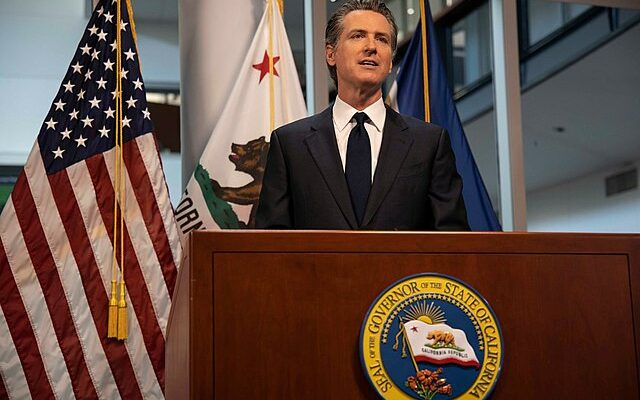
By It’s not just Tim Walz and Minnesota. A blistering new report from the California State Auditor has raised alarms over what it describes as widespread fiscal vulnerabilities across state government, identifying as much as $76.5 billion in potential waste, fraud, and mismanagement spanning eight major agencies.
The nonpartisan audit, released December 11, 2025, places California’s handling of pandemic relief funds, social-welfare programs, homelessness spending, and major infrastructure projects under renewed scrutiny—while igniting an immediate political backlash from Republican critics of Gov. Gavin Newsom’s administration.
Titled “The California State Auditor’s Updated Assessment of Issues and Agencies That Pose a High Risk to the State,” the report designates multiple agencies as “high risk,” citing failures in oversight, internal controls, and corrective action. Among its most consequential findings are $32 billion in alleged COVID-19 relief fraud tied largely to emergency aid programs overseen by the Department of Finance; $2.5 billion in improper payments within CalFresh, the state’s food-stamp program; $18 billion spent on the high-speed rail project with no completed track segments to date; and between $24 billion and $37 billion in homelessness spending that auditors say cannot be reliably tracked, even as homelessness has risen roughly 20 percent statewide.
The audit does not accuse individual officials of criminal conduct, but it paints a stark picture of systemic breakdowns—particularly during the rapid expansion of government programs amid the COVID-19 pandemic.
The report’s release quickly spilled into national politics. During a Newsmax appearance on December 24, Republican Rep. Kevin Kiley labeled California the “fraud capital of America” under Newsom’s leadership, remarks that ricocheted across social media.
On Twitter, critics pointed to the audit as evidence of deeper governance failures. An online poll conducted December 23 by @mistressdivy asking users whether they would support Newsom in a hypothetical 2028 presidential race drew overwhelmingly negative responses. Actor James Woods added, “He doesn’t care. And the idiots who will vote for him don’t care either.”
He doesn’t care. And the idiots who will vote for him don’t care either. https://t.co/seZBa93F2m
— James Woods (@RealJamesWoods) December 23, 2025
Kiley further argued that California’s problems dwarf those of other Democratic-led states, writing, “The waste and fraud in California is far beyond anything in Minnesota. It isn’t even close.”
The State Auditor’s office uses a long-standing framework to designate agencies as “high risk,” requiring evidence of potential serious harm, a substantial likelihood of problems recurring, inadequate corrective measures, and the possibility that audits could meaningfully reduce the risks. Auditors noted that the number and scale of high-risk findings have grown markedly during Newsom’s tenure.
The audit arrives amid heightened national concern over emergency-era spending, especially in states run by Democrats. Federal prosecutors have recently secured multiple convictions tied to pandemic relief fraud, reinforcing auditors’ warnings about the vulnerabilities created when massive sums are distributed quickly with limited safeguards.
The pandemic isn’t the only place where Newsom and his merry band of liberals have seen emergency funds go to their pals instead of those who need it. A celebrity-backed fundraiser, FireAid, raised roughly $100 million with the stated goal of helping wildfire victims rebuild. Months later, critics and donors began questioning why victims were not receiving aid. Reporting cited in the article claims that large portions of the money were instead routed to nonprofits advancing progressive or ideological agendas rather than providing direct disaster assistance.
According to the reporting, funds from designated “disaster relief” pools went to organizations that explicitly restrict eligibility based on race, prioritize undocumented immigrants, or focus on political activism and voter engagement rather than housing, rebuilding, or emergency aid. Some grantees reportedly emphasize “Black power,” exclude white applicants, support anti-ICE activism, or provide legal and political services unrelated to wildfire recovery.
So far, only one house has been rebuilt since the fires last January.
The dysfunction in California will likely define the Democratic Party. Gavin Newsom is emerging as the early front-runner for the 2028 Democratic presidential nomination, but party strategists increasingly see him preparing for a direct primary fight with former Vice President Kamala Harris, who has begun making unmistakable moves toward another White House bid. Recent polling has shown the two Democrats running neck and neck, underscoring a rapidly crystallizing rivalry inside a party still searching for a post-Biden identity. Newsom, long viewed by donors and operatives as a natural heir to the party’s progressive establishment, is working to consolidate support while quietly bracing for intensified scrutiny from Harris-aligned factions.
Harris, meanwhile, continues to poll at or near the top of the Democratic primary field, buoyed by strong backing among Black voters and reinforced by a carefully calibrated public reemergence that includes an expanded book tour, appearances in early primary states, and higher-profile engagement with party leadership. Her sharpened rhetoric and national positioning have heightened unease among Newsom allies, who worry that Harris’s base support could fracture the coalition he needs to secure the nomination.
[Read More: Trump Kicks Freeloaders Off The Dole]