 By
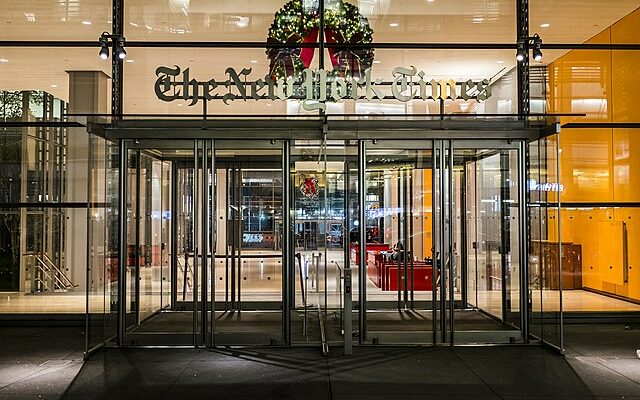
By For the first time in more than half a century, The New York Times has lost a U.S. defamation case involving one of its articles, with an Alabama federal jury ordering the newspaper Thursday to pay $9.25 million to a former University of Alabama basketball player falsely placed at the scene of a murder.
The verdict is particularly striking for a newspaper that has spent decades successfully defeating defamation claims, including a highly publicized, years-long lawsuit brought by former Alaska Gov. Sarah Palin.
This time, the plaintiff was Kai Spears, a former Alabama basketball walk-on who said the Times wrongly associated him with the January 2023 shooting death of 23-year-old Jamea Harris in Tuscaloosa.
After a nine-day trial in U.S. District Court, jurors found the Times liable for both defamation and false light invasion of privacy. They awarded Spears $9.25 million, including roughly $7.5 million in punitive damages.
The case centered on a March 15, 2023, article by Times sports reporter Billy Witz about the fatal shooting and Alabama basketball star Brandon Miller.
The article reported that Spears, then a freshman walk-on, had been a passenger in Miller’s car during the early-morning hours of Jan. 15, 2023, near the Tuscaloosa Strip. The vehicle was struck by gunfire during the incident.
But Spears wasn’t there.
The passenger was Alabama team manager Cooper Lee. Spears was several blocks away in another vehicle and had no knowledge of what was happening at the shooting scene.
Former Alabama player Darius Miles and another man were charged in connection with Harris’s death. Neither Miller nor Lee was charged.
The Times eventually acknowledged its mistake, publishing an editor’s note on June 2, 2023, correcting Spears’s identification. But Spears argued that by then the damage had been done: One of the world’s most prominent newspapers had placed his name at the scene of a killing.
At trial, Spears’s lawyers focused on the Times‘ reliance on anonymous sourcing and the steps—or lack of them—that reporters took to verify who had actually been inside Miller’s vehicle.
Witz apologized from the witness stand for incorrectly identifying Spears but maintained that he had followed the newspaper’s reporting standards. Lawyers for the Times characterized the report as an honest mistake and questioned whether Spears had suffered the level of harm alleged, pointing in part to his later receipt of a basketball scholarship.
The jury wasn’t persuaded.
Spears had an important legal advantage that several other prominent plaintiffs who have taken on the Times did not: He was a private figure. Under Alabama law, that meant he did not have to clear the formidable “actual malice” hurdle imposed on public officials and public figures. Instead, he could prevail by showing that the Times negligently published a false statement about him.
That distinction has helped the Times survive some of the most closely watched defamation battles in American media.
Palin spent nearly nine years pursuing the newspaper over a 2017 editorial that falsely suggested a connection between a map circulated by her political action committee and the 2011 shooting that severely wounded then-Rep. Gabrielle Giffords.
Palin’s case survived dismissals, appeals and a 2022 trial that was later thrown out because of errors by the trial judge. But when the case finally returned to a Manhattan jury in April 2025, the Times won again. Jurors found Palin had failed to establish that the newspaper acted with actual malice when it published the erroneous claim.
President Donald Trump has also repeatedly gone after the newspaper in court. One lawsuit over the newspaper’s Pulitzer Prize-winning reporting on his family’s taxes was dismissed, and Trump was ultimately ordered to pay nearly $400,000 in the Times‘ legal fees.
Project Veritas similarly managed to push a defamation lawsuit against The Times past an early motion to dismiss in a case involving the newspaper’s characterization of its 2020 reporting on alleged ballot harvesting in Minnesota. A New York judge ruled in 2021 that the organization had presented enough evidence to proceed with discovery, an unusually significant early setback for the Times, though it never resulted in a jury verdict against the newspaper.
The Alabama verdict therefore represents something considerably more unusual: an actual jury finding that the Times defamed someone.
There is also some historical symmetry to where it happened.
The modern legal protections that have made cases against the Times so difficult to win trace back to New York Times Co. v. Sullivan, the landmark 1964 Supreme Court case that also arose in Alabama. An Alabama jury had awarded Montgomery public safety commissioner L.B. Sullivan $500,000 after the Times published an advertisement containing factual errors about civil rights demonstrations.
The Supreme Court unanimously overturned that judgment and established the “actual malice” standard, requiring public officials—and later public figures—to prove that defamatory falsehoods were published with knowledge of their falsity or reckless disregard for the truth. That ruling transformed American defamation law and gave newspapers sweeping protection against lawsuits arising from mistakes in reporting about public figures.
More than six decades later, another Alabama jury has handed The Times a defamation verdict—this time under the lower legal standard applicable to a private citizen.
The Times signaled Thursday that the fight is unlikely to be over.
Times spokesman Charlie Stadtlander said the newspaper was “disappointed the jury found The Times liable for an honest mistake.”
He added that the company believes “the verdict and award of damages are contrary to law and not supported by the evidence” and said the newspaper is reviewing its legal options.
Spears, meanwhile, thanked the jurors and his attorneys after the verdict.
“My hope is that we all lead with love and always seek the one constant truth in this life,” he said.
His father, Christian Spears, said the family initially wanted something much simpler from the newspaper: a retraction.
Instead, three years later, the dispute ended with a $9.25 million verdict and the Times‘ first defamation loss involving one of its articles in more than 50 years.
[READ MORE: ISIS Tried To Bomb A State Capitol]