 By
By The Trump administration has imposed visa restrictions on five European individuals, including a former senior European Union official, escalating a transatlantic dispute over digital regulation, free speech, and the reach of foreign governments into the operations of American technology companies.
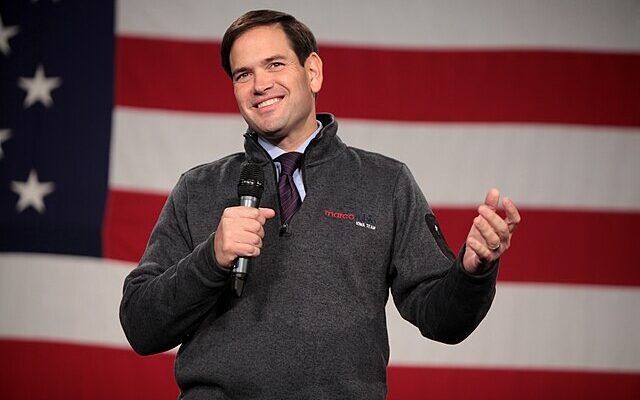
Secretary of State Marco Rubio announced the move Tuesday, saying the targeted individuals were involved in “organized efforts to coerce American platforms to censor, demonetize, and suppress American viewpoints they oppose.” Rubio said the actions were part of a broader campaign that has “advanced censorship crackdowns by foreign states—in each case targeting American speakers and American companies.”
Europe has been sliding into totalitarianism, especially on free speech, for years.
The visa restrictions are tied to U.S. objections to the European Union’s Digital Services Act, or DSA, a sweeping regulatory framework that requires large online platforms to more aggressively police content deemed unlawful under EU law, with steep financial penalties for noncompliance, writes CNBC. American officials have argued the law places disproportionate burdens on U.S.-based companies and effectively reaches across borders to influence speech originating in the United States.
Among those affected is Thierry Breton, who served as the EU commissioner for the internal market from 2019 to 2024 and was a central architect of the DSA. Responding on Twitter, Breton wrote: “Is McCarthy’s witch hunt back?” He added: “As a reminder: 90% of the European Parliament — our democratically elected body — and all 27 Member States unanimously voted the DSA.” Breton also addressed American audiences directly, writing: “To our American friends: “Censorship isn’t where you think it is.”
European leaders and institutions swiftly condemned the U.S. decision. The European Commission released a statement asserting that “Freedom of expression is a fundamental right in Europe and a shared core value with the United States across the democratic world,” while emphasizing the EU’s authority to regulate its own market under democratic principles. The commission said it was seeking clarification from Washington regarding the scope and justification of the restrictions.
Current European Commission President Ursula von der Leyen also weighed in on Twitter, stating: “Freedom of speech is the foundation of our strong and vibrant European democracy. We are proud of it. We will protect it.”
Freedom of speech is the foundation of our strong and vibrant European democracy.
We are proud of it. We will protect it.
Because the @EU_Commission is the guardian of our values. https://t.co/J7u6GIyi6J
— Ursula von der Leyen (@vonderleyen) December 24, 2025
French President Emmanuel Macron denounced the visa bans as “intimidation and coercion aimed at undermining European digital sovereignty.” He added: “The European Union’s digital regulations were adopted following a democratic and sovereign process by the European Parliament and the Council.” Macron further emphasized that the DSA “does not target any specific third country but is designed to ensure that what is illegal offline is also illegal online.”
According to U.S. officials, the remaining individuals subject to the restrictions are leaders of organizations focused on combating online hate speech and disinformation, including Germany-based HateAid. Under Secretary of State for Public Diplomacy Sarah Rogers publicly identified the targets on Twitter portraying the action as a clear warning against foreign efforts to influence American speech.
The move underscores growing tensions between Washington and European capitals over digital governance, content moderation, and the global power of major technology platforms. U.S. officials have increasingly framed the dispute as a defense of American free-expression norms against what they describe as extraterritorial regulation while Europeans have continued to demand censorship of their own people and continually use their anti-free speech laws to fine American companies as a key source of revenue.
EU makes more from fines on US tech, than tax from ALL of public European tech
in 2024 EU fined US tech companies €3.8B meanwhile public internet tech companies paid only €3.2B in income tax https://t.co/U5YiH2Hvsa pic.twitter.com/WS16XX66Ll
— david fant (@da_fant) December 8, 2025
Europe makes more money from creating regulatory systems than building its own tech industry.
[Read More: Rand Releases Waste Report]